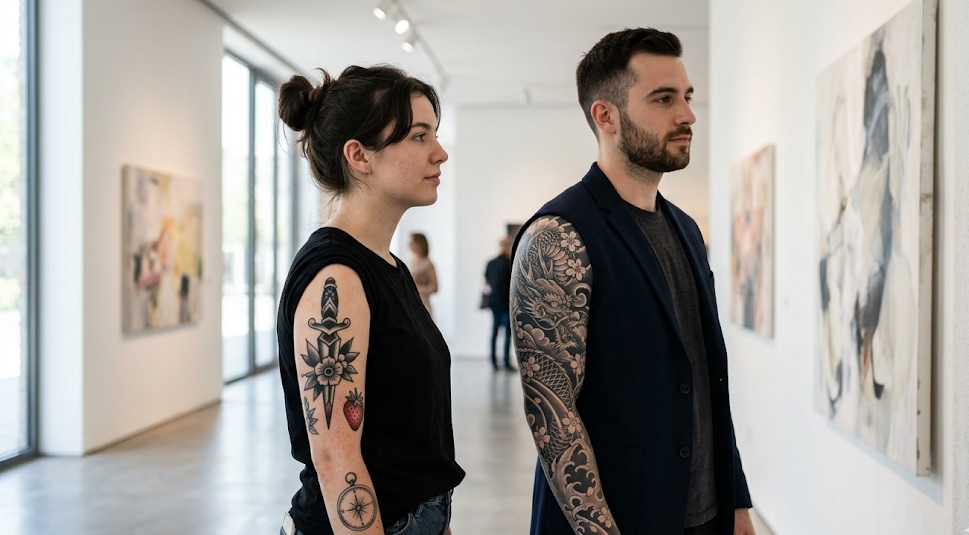
This is a certain type of anxiety that occurs approximately thirty minutes into a tattooing session. You are on the table, the needle is buzzing, and you look at your arm- a collection of your favorite flash designs, travel souvenirs, and inside jokes you curated.
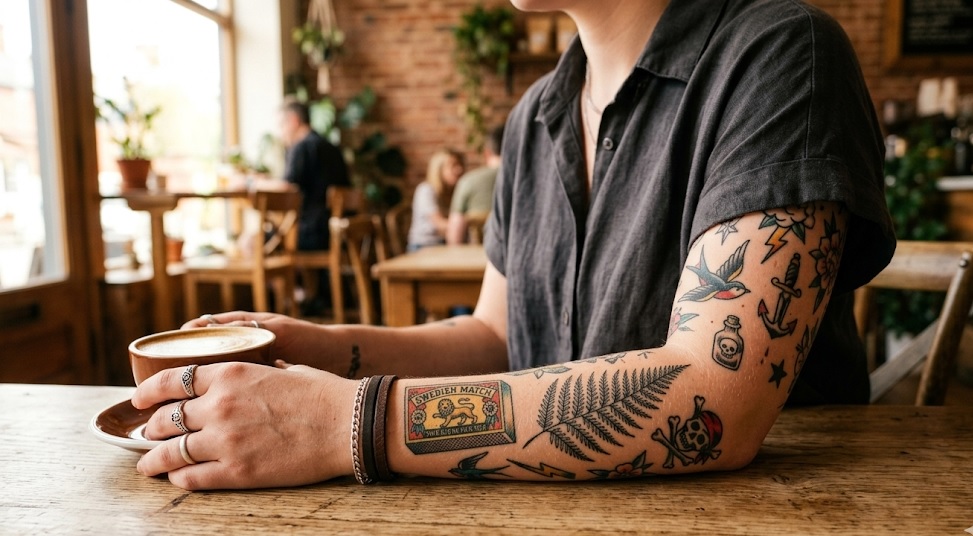
You see that the delicate fern you acquired in Portland does not exactly fit the pirate skull you acquired in Miami, and neither of them will fit the biomechanical forearm, which you would like to have just next year. Such is the intersection that all collectors must pass: Do you paint a gallery, or a mural?
What about a patchwork approach?
Patchwork tattoos, also known as “stick-and-poke style” or just “random collectibles,” are just what they are called. They are personal objects, which are typically spaced by negative space and which standalone without the need for each other.
Check the pros of patchwork
- Freedom & Flexibility: You have the option to get tattooed by the artist of your choice on vacation and not invest in getting a full sleeve. There is no “theme” to maintain.
- No, I want a dagger, now: Instant Gratification. You get a dagger. You want a strawberry? You get a strawberry. No waiting to fill in a background or a cohesive scene.
- Less Pressure: When you find yourself disliking that dagger, it is one small thing, one tiny item to wrap or laser and not a whole universe to your arm.
- The “Collected” Look: A patchwork sleeve is supposed to look. When it’s done properly, it feels and looks casually cool–as an old flash wall on your skin.
What about cons?
- The Fill-In Panic: This is the largest trap. In five or six articles, you find you have strange holes. You end up getting filler tattoos because you just need to close the skin, instead of getting tattoos that you are passionate about.
- Flow Problems: The human body flows. Patchwork tattoos, which are restricted in their limits at times, appear stagnant and do not flow along muscle structures.
- Theme Clash: That realistic portrait of a photograph could fit in with a classic American eagle.
Learn about body suit philosophy
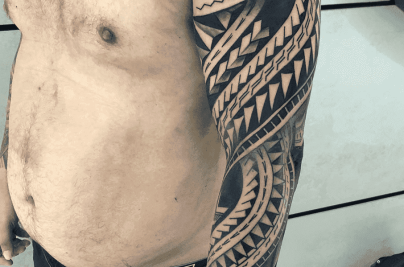
This is the technique of collaborating with an artist (or a rigorous personal agenda) to create a harmonious, flowing composition of art that employs the organic shapes of the body. This does not always imply one single image, but rather a single background or theme that links all of them together.
Learn about the pros
- Anatomical Flow: Masterpiece work applies the body as a canvas. The body suits and biomechanical works that are done in large scale are aimed at improving muscle movement, and thus the art appears to be alive.
- No Wasted: Skin: Each inch of the limb is explained. The strange, vacant shapes of diamonds have been left behind.
- Visual Effect: A cohesive sleeve possesses a “wow” effect that a patchwork sleeve cannot have. It does not look like a series of statements but as one strong statement.
Check the cons
- The Monotony Risk: You must love that theme; you have to love it. When you get a complete Norse mythology sleeve and later realize that you hate Vikings, you will have an expensive and painful cover-up.
- Artist Dependency: You have had to stay with one artist for years so as to be consistent in style, shading, and color palette.
- The Cost of Dedication: Masterpieces involve a huge investment of time and money in the beginning.
Making a future-proof canvas
Then how do you make the choice of the right direction? The good thing is that you do not have to choose sides until there is an absolute need to do so. This is what one can do to navigate the process without regretting.
Importance of orientation
When leaning Patchwork, you have to tattoo against the body and not against it.
Do: Lay swords, daggers, or bones, long, thin, along the length of the limb. This elongates the body.
Don’t: Wrap an underarm-sized banner around a bicep, so that there is no room to add a vertical tattoo in the future.
What is the background strategy?
You may very well begin Patchwork and finish Masterpiece . A lot of collectors use 10-12 years to fill their arm with different random pieces, and when the arm becomes full, they have a background style (wind bars, waves, dark shading) which ties all the unrelated things together.
The Trade-off: This also provides cohesion, although it makes the entire appearance of the tattoo a bit darker, and it also makes reading your own individual pieces a little more difficult.
Respect towards real estate
Imagine your torso and thighs are real estate to be sold. Your chest and back are an enormous canvas on which to paint gigantic, symmetrical, great works.
Rule of Thumb: Save big flat areas for big flat art. Spare the limbs (twist and turn) to either vertical patchwork ideas or flowing sleeves.
Cohesion through contrast
Without a theme, you can achieve cohesion, should you persist with Patchwork. The ability to remain consistent with a style (e.g., all American Traditional, all blackwork, all fine-line) forms a uniting thread. A sleeve that is full of American Traditional flash will always do better with a sleeve than one that is mixed with watercolor and tribal.
And there is no right or wrong, there are just informed decisions. The patchwork method is appropriate for the spontaneous collector who perceives his/her body as a travel diary. The Masterpiece strategy will be befitting the visionary who considers his/her body a museum display.
Make a picture of your limb before you reserve your next appointment. Illustrate future pieces that may be purchased through the use of an editing app. When the shapes begin to appear sloppy and uncontrolled, there may be a call to change the sticker-gathering strategy to a commissioned painting.
Your skin is all you will ever paint in life–don’t make a poor frame to a good picture.
FAQ
Can we turn patchwork tattoos into a cohesive sleeve tattoo?
Yes. A lot of artists are able to introduce backgrounds such as shading, smoke, wind bars, or even geometrical patterns, and tie up your pieces. This gives the appearance of one piece without removing any of your existing tattoos, although it will dullen the overall appearance.
Which tattoo style works best as a patchwork sleeve?
The American Traditional is most preferred since its solid colors and bold lines complement each other. Illustrative and blackwork styles are also good. Exquisite or watercolor works may occasionally be lost to sight between more emphatic tattoos.
How to choose the right tattoo artist from the pool of artists?
In case you desire a flawless work of art with harmonized shading, use the services of a single artist. Patchwork will be the most convenient choice in case you appreciate diversity and like having different works of various guest performers or trips. All you need to do is make sure that they are stylistically compatible.
What is the best area of our body for testing patchwork and masterpiece tattoos?
Large masterpieces are best displayed in flat, broad regions such as the chest, back, and thighs. Limbs–arms and legs–are very generous to patchwork: as they are cylindrical, you can see separate pieces at different angles.
Is it cheap to get a patchwork tattoo than a full sleeve one?
In most cases, a commissioned sleeve that has been planned can be a better long-term investment since you are paying to have a composition designed, and less time is wasted. Patchwork may have to be made in several deposits, charged more per hour for small pieces, and some filler may have to be added later to seal gaps.

Marco Ventura is a globally award‑winning tattoo artist based in Australia, renowned for his expertise across diverse tattoo styles. As the founder of his own studio, he leads a talented team dedicated to turning personal stories into striking body art. Passionate and visionary, Marco helps clients worldwide bring their tattoo dreams to life. He also shares his thoughts about tattoos and how things can be better for the clients through engaging blog posts.