Tattoos of Australia’s coastlines have been a popular choice among tattoo enthusiasts for a long time. Palm trees, crashing waves, compass designs, or simple geographic coordinates were used for years by surfers, divers, and beach lovers to mark their favorite coastal locations. But today, there’s a new art movement that is taking topographical contour linework to the ocean:
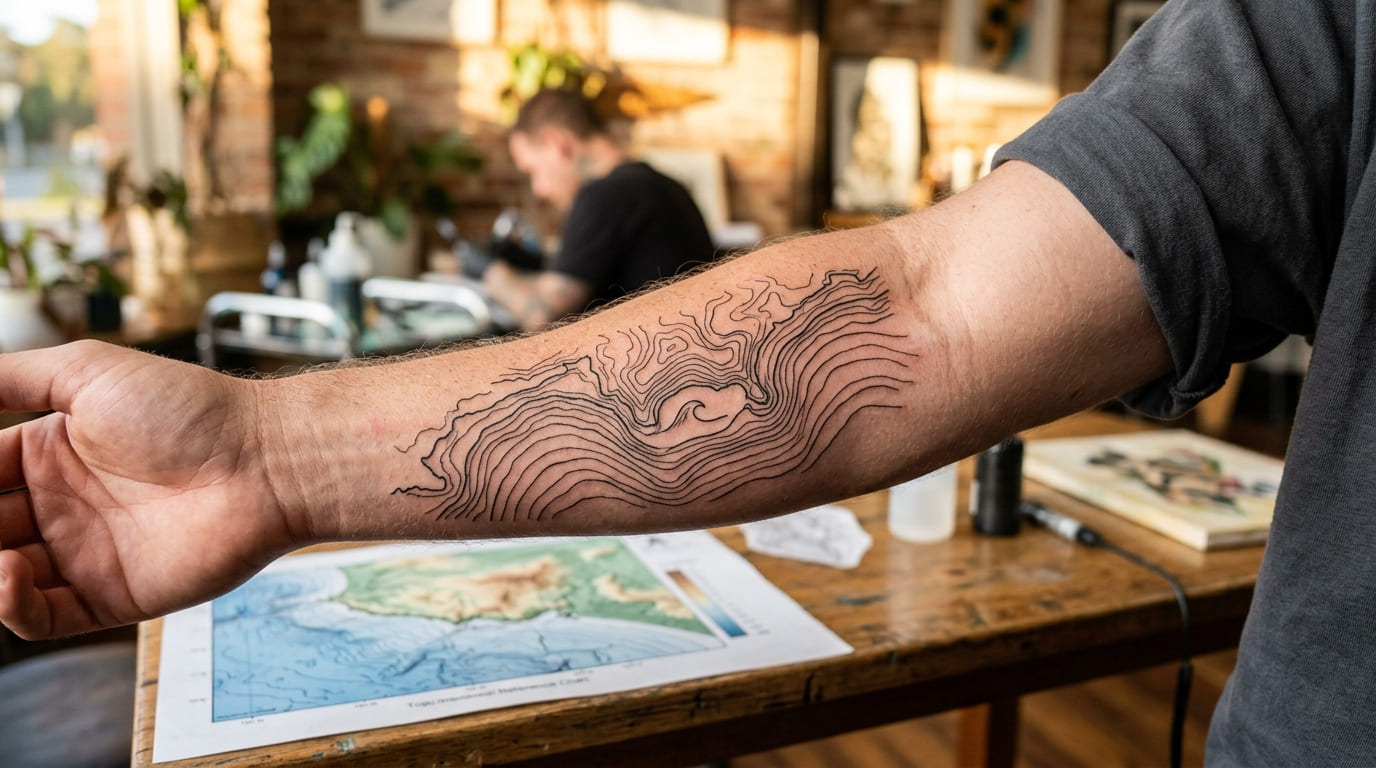
This is not a sea creature, but rather a representation of the landscape, with contour lines that flow over and under the surface to symbolize natural landscape, depth, and elevation. From the crystal-clear waters of Rottnest Island to Byron Bay’s famous surf, Bells Beach’s rugged coastline to the dramatic East Coast of Tasmania, the abstract designs were inspired by any of Australia’s iconic coastal experiences.
What is a Topographical Contour Line Tattoo?
Topographical contour tattoos are layers of continuous lines, much like topographic or bathymetric maps. Rather than the realistic visuals of a place, the tattoo will make the distinctive shapes of a place appear as an exquisite piece of abstract art.
The outcome is a clean, geometric design which has a personal touch yet is visually subtle.
Popular inspirations include:
- Rottnest Island
- Byron Bay
- Bells Beach
- Tasmania’s East Coast
- Great Ocean Road
- Ningaloo Reef
- Margaret River
- Noosa Heads
Patterns are unique to each coastline, and no two contour tattoos are the same.
What are the Reasons Behind the Growing Trend in Australia?
Surf culture is not just about beaches; it’s about identity, adventure, and connection with nature. It’s about us in Australia. However, many people wish to have tattoos that tell of these experiences without being overt.
Topographic contour linework provides just that.
Some of the reasons for its popularity are:
- Minimalist aesthetics
- Highly personal symbolism
- Elegant black line designs.
- Easy to incorporate into larger tattoos.
- Modern artistic appeal
- Ideal for non-surfers as well as surfers.
Rather than announcing to the world where you’ve been, contour tattoos silently depict the significance of the locations.
Why are Contour Lines Replacing Coordinate Tattoos?
| Feature | Topographical Contour Tattoos | Geographic Coordinate Tattoos |
| Visual Appeal | Artistic and flowing | Text-based and minimal |
| Uniqueness | Every landscape creates different patterns | Mostly numbers and symbols |
| Scalability | Easily expanded into sleeves or larger pieces | Difficult to expand creatively |
| Conversation Value | High | Moderate |
| Modern Design Trend | Increasingly popular | Classic but more common |
Inspiring Trends
- Rottnest Island
Underwater contours in Rottnest are smooth and layered, with turquoise waters and limestone reefs, making it perfect for minimalist tattoos.
- Byron Bay
The dramatic curves of the coastline of Australia’s iconic surf destination are transformed into elegant compositions.
- Bells Beach
Its rugged cliffs and powerful surf breaks impart bold contour variations, well suited to line work.
- Tasmania’s East Coast
Maps of rocky inlets, secluded bays, and dramatic changes of elevation produce intricate maps with exceptional visual depth.
Natural geography and not literal illustrations are used to tell each location’s story.
Why Minimalism Wins?
Minimalist tattoos remain popular as they look great with almost any style and age well.
Contour tattoos offer:
- Fine-line precision
- Reduced visual clutter
- Excellent readability
- Easy to place on a smaller surface area of the body.
- Sophisticated appearance
- Gender-neutral styling
Evocative communication without overwhelming detail.
Selecting the Appropriate Placement
The contour lines are connected so that artists can use fluidity to modify designs to create natural movement in the body.
Popular placements include:
- Inner forearm
- Upper arm
- Shoulder blade
- Calf
- Ribcage
- Ankle
- Chest
- Spine
Long contour designs are good for the forearm or calf, in areas where the body’s shape will enhance the natural flow of the artwork.
Tips Before Getting a Contour Tattoo Are Best Avoided
It makes sense that preparation can really make a difference in the result.
Consider these recommendations:
- Select a coastline that has a personal significance.
- Work with an artist experienced in fine-line tattooing.
- Use high-resolution topographical or bathymetric reference maps.
- Talk about line thickness to prevent confusion over the years.
- Don’t make the design too small or too numerous over time, as they could get blurred.
- If you are thinking about adding to the sleeve in the future to make it a bigger coastal theme, you may want to consider these things.
In planning, time is crucial in maintaining the appearance and meaning of the tattoo.
Matching Contour Tattoos with Other Minimalist Designs
Many people use contour mapping in conjunction with complementary designs that are used to enhance the contour map.
Popular additions include:
- Small compass symbols
- Single wave lines
- Crescent moons
- Southern Cross constellations
- Surfboard silhouettes
- Native Australian flora
- Ocean currents
- Sunrises
These details do not distract from the contour lines that make up the artwork, but are added to increase the richness of the drawing.
The Future of Tattoo Design Is Coming to An End
Minimalist tattooing is constantly changing, and clients are looking for designs that blend personal expression with contemporary style. The topographical contour linework is an excellent representation of this change, because it depicts, in abstract form, wearable art of the very real landscape.
Instead of literal representations of beaches or waves, artists are taking the geography itself to be the design. The outcome is a tattoo that is contemporary, timeless, and personal.
The topographical contour linework is changing the way Australians celebrate their favorite beaches and surf breaks with tattoos in a more elegant and clean way, replacing the traditional coordinate tattoo with topographical maps.
Motivated by the reefs of Rottnest Island, the rolling surf at Byron Bay, the legendary waves at Bells Beach, or Tasmania’s stunning coastline, contour tattoos offer a meaningful way to connect with place, without the need to resort to traditional imagery of the ocean. Topographical mapping is one of the most unique and lasting tattoo styles of the current time and is an ideal choice for a refined, minimalist, adventure & identity style tattoo.
FAQ
What is a topographical contour line tattoo?
A topographical contour line tattoo is a minimalist tattoo made up of a number of contours that represent the unique geography of the given location. This tattoo does not depict realistic scenery but rather an abstracted version of it through lines that indicate the depth of water or the height of mountains.
Why are contour line tattoos becoming more popular than coordinate tattoos?
Contour line tattoos, in contrast to coordinate tattoos, may be considered more artistic and less straightforward. Such tattoos can also be seamlessly integrated into more complex tattoo projects, offering a more contemporary and sophisticated appearance, which can be particularly appealing to minimalist tattoo styles.
Which Australian coastal locations work best for contour line tattoos?
The researchers have identified a number of popular tattoo destinations, including Rottnest Island, Byron Bay, Bells Beach, Tasmania’s East Coast, Margaret River, Noosa Heads, and the Great Ocean Road. These places are renowned for their unique geography, and hence the tattoo of each of these places is different and special in its own way and closely connected with the life path of the customer.

Marco Ventura is a globally award‑winning tattoo artist based in Australia, renowned for his expertise across diverse tattoo styles. As the founder of his own studio, he leads a talented team dedicated to turning personal stories into striking body art. Passionate and visionary, Marco helps clients worldwide bring their tattoo dreams to life. He also shares his thoughts about tattoos and how things can be better for the clients through engaging blog posts.