

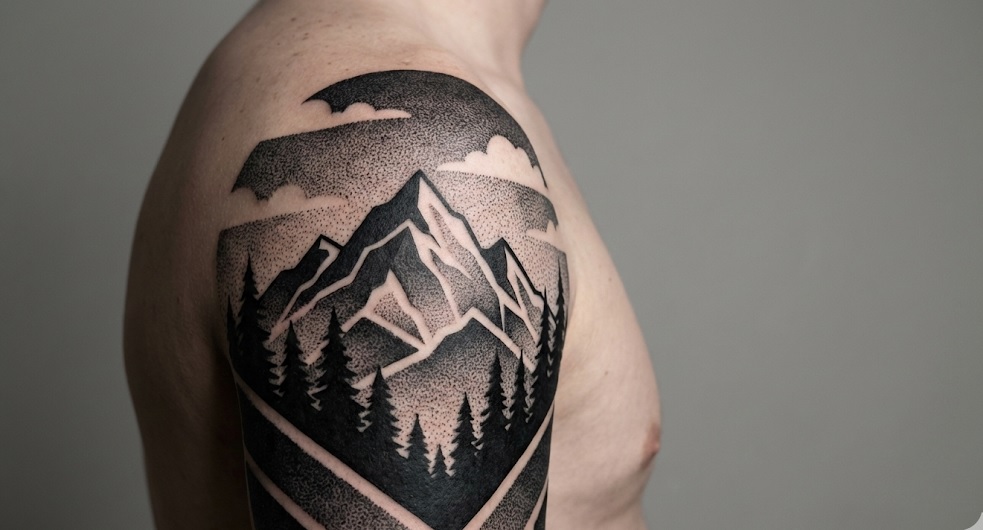
Amidst the colorful realm of tattoo art, where color usually takes the centre of the stage, there is a place of serious undertones and great contrast. It is the province of blackwork and dotwork, a form that abandons the rainbow to concentrate on the necessary conversation that takes place between ink and skin, between solid form and space.
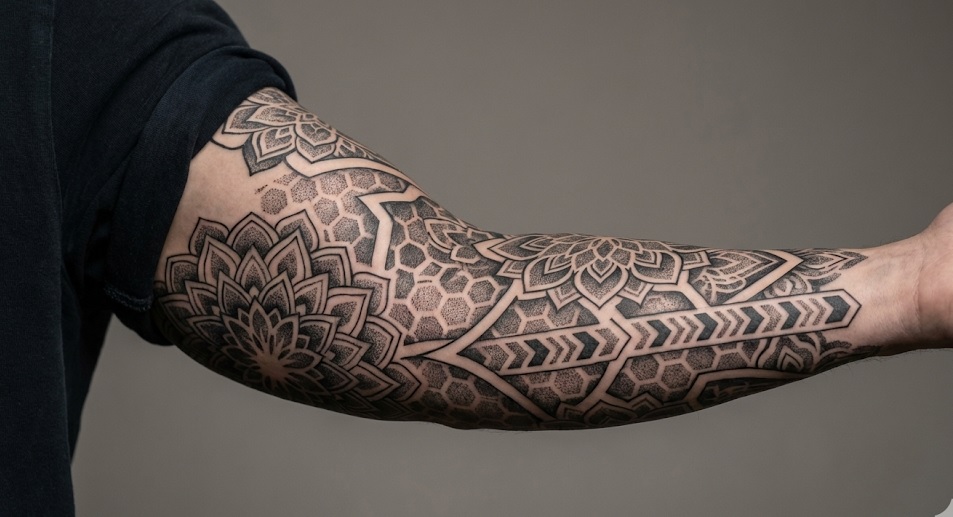
It is a science of the nothing as well as the something, forming a visual symphony that is not only technically challenging but also breathtaking.
This is not merely concerning black ink; it is a philosophy. It is an experiment with light, shadow, and texture, which is produced with the most basic tools. Let us explore the essentials upon which this style is so fascinating.
Check the Core Philosophy
The negative space is worked out quite brilliantly at the core of strong blackwork and dotwork. This is contrary to other styles, which seek to create a photorealistic shade, since the untouched skin is the central command of the design.
- Imagine it is a sculpture with light. The artist does not simply apply ink; he or she plans where to take away the ink on the composition to enable the natural skin tone to create highlights, create a separation, and shape.
- The method avoids making the design look like a solid heavy block of black; it gives it a breath, movement, and a special luminosity. The outcome is a tattoo that does not seem like it was put on top of the body, but appears to be part of it.
Understand the Tapestry of Tattoo Styles
The principles of black and grey are finally implemented into a number of different but related styles. The negative space and dotwork are utilized differently by each of them to create an effect.
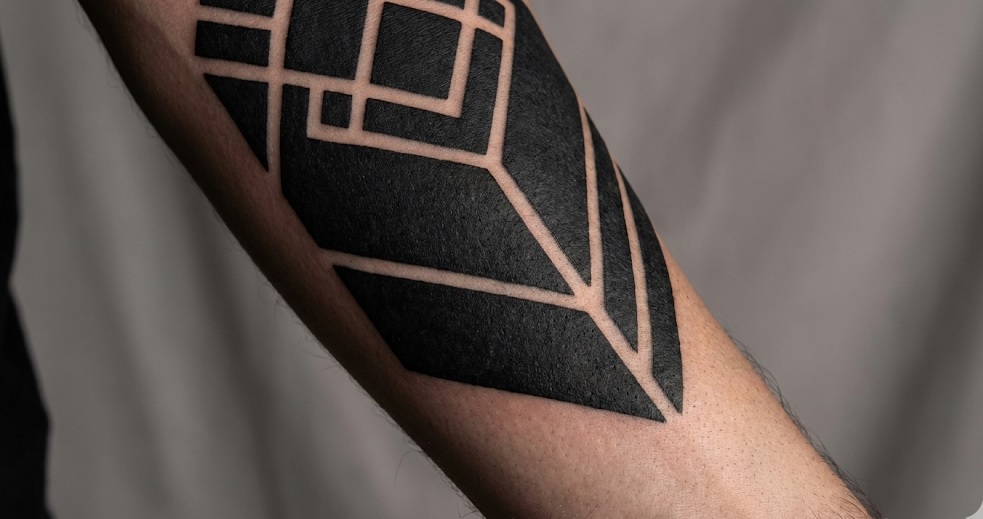
Ornamental and Geometry Tattoos
It is a style inspired by historic ironwork, architecture, and spiritual patterns and features patterns, featuring intricate and repeating patterns. The characteristics include flowing lines, sharp angles, and complicated symmetry.
Negative space is applied in this instance so as not to clog the eyes with details; this way, the eye can trace the elaborate designs of the work without feeling overwhelmed. An ideally done ornamental work is virtually a musical rhythm and balance.
Mandala Tattoos
The Sanskrit word mandala (meaning circle in Sanskrit) is a spiritual and ritual image that symbolizes the universe. As a tattoo, it is the final challenge of an artist and the knowledge of symmetry.
Dotwork is also particularly suitable for the mandalas, where thousands of small dots may provide the subtle tonal transition required to provide a flat, circular design with a breathtaking sense of volume. The focal point, or bindu, of the mandala may serve as the pivot of the patterns, spreading outward, and balanced together by the delicate play of ink and space.
Dotwork Tattoos as The Foundation
The Texture, The King: Dotwork is a style as well as an essential technique. With an infinite number of dots of different sizes and densities, artists can achieve unbelievably high levels of effects:
A dense group of dots can be switched to a sparse scattering to produce soft shadows and smooth transitions, which would otherwise be difficult to produce using the old-fashioned shading technique.
Dotwork may resemble stone, grains, cloth, or even ambient sound, and the tattoo may feel almost like it.
Due to the visibility of the skin between the dots, the nature of a dotwork tattoo is that it is inherently light; thus, it is ideal in large-scale works that are open to the eye without creating a feeling of heaviness as a solid section of black.
Tips that Will Change Your Blackwork and Dotwork Tattoo Outcome
To go out and grab a blackwork or dotwork tattoo, one has to do so in a particular way. These are some of the tips that will make you sure of getting something to love over a lifetime.
Always Focus on Choosing the Right Tattoo Artist
This is the most desperate step. This is not a style that all artists specialize in. Find a professional whose page will be full of clean, sharp linework, perfect symmetry, and traces of skillful dotwork. You do not only pay money for ink, but also for their patience and precision.
Importance of the Design Process
These are custom-designed tattoos that are usually tailor-made to the contours of your body. Listen to your artists regarding the manner in which the design can go with your musculature and anatomy. A mandala on a knee will be made very different compared to the flat back.
What about Time Commitment?
Accuracy is a time-consuming activity. Many long sessions will be needed in case of a complex geometric sleeve or a large back-piece mandala. A good dotwork tattoo cannot be in a hurry. Patience is not a virtue, but a necessity.
Relation Between Placement and Longevity
Places where stretching or friction is pronounced (such as fingers or sides of feet) can lead to loss of fineness and dots that are smaller in size and are more easily smeared out as time progresses.
The Right cure is of the essence. Carefully follow the aftercare advice of your artist to prevent fallout of ink that can leave gaps in dots that have been laid out with a high level of accuracy.
Communication Clarity. Are you ambitious and graphic, or subtle and airy? Also, bring reference images of how you feel, not necessarily the specific design that you would desire.
The blackwork and dotwork describe the revival of key aspects of art, namely, line, form, and contrast. It is a style which requires technical mastery and an artistic vision, which is that the most powerful utterances are not always made with a scream of colour, but with the refined murmur of black, grey, the lovely deliberate space between. A mute symphony of the flesh it is, an eternal contemplation of the beauty of a balance.
FAQ
Do dotwork tattoos hurt more than normal tattoos?
The subjectivity of pain is not tangible; however, the procedure may be tangible. Rather than a scraping, it is a quick, accurate prickly sensation. It is more manageable to some people and more intense in one aspect, according to others. It is a matter of each person and location.
What are the impacts of these tattoos over time?
They grow old beautifully because of the knowledge of an artist and with the right treatment. The fineness of the lines can slightly blur, and the dotwork can slightly stretch, yet the main design and contrast are effective. The plain, the poorly spaced designs, sufficed by the negative space, are the most resilient designs in the long run.
Can you only get geometric and spiritual designs as blackwork tattoos?
Not at all! Although it is archetypal of geometric patterns, mandalas, and ornamentation, the approaches are exceedingly diversified. Dotwork is employed by artists who seek realistic textures, portraiture, as well as organic subjects, and stippling provides depth and shadow to forms beyond the structured ones.
How much time will it take to create dotwork tattoos?
Precision cannot be rushed. The placement of each dot is done manually in order to produce gradients and textures. The construction of density using millions of tiny, single marks is a very tedious and long procedure, and it takes a lot of patience on the part of the artist and the client to have the perfect outcome.
What are some major factors related to aftercare?
Infection prevention and ink fallout prevention. Wash tenderly using an unscented soap, dry off, and apply sparsely using the recommended ointment. Most importantly, never pick or scratch the healing tattoo when it is peeling because this may drag out the dots and destroy the complicated shading.

Marco Ventura is a globally award‑winning tattoo artist based in Australia, renowned for his expertise across diverse tattoo styles. As the founder of his own studio, he leads a talented team dedicated to turning personal stories into striking body art. Passionate and visionary, Marco helps clients worldwide bring their tattoo dreams to life. He also shares his thoughts about tattoos and how things can be better for the clients through engaging blog posts.

